October 2026 – Speak of the Devil Weed Queen
K9 Qana and CDH’s Invasive Plant Program
By Kyoko Johnson
Devil weed (Chromolaena odorata) was the first target species and project we pursued as a non-profit organization. It was the start of our Invasive Species program, which now includes Coconut Rhinoceros Beetle and Little Fire Ants. We thought you might be interested in hearing the origin story…
How did CDH decide to train dogs to detect devil weed?
In 2019 we contacted O‘ahu Invasive Species Committee to see which target might be suitable for a volunteer detection dog project.
They recommended devil weed because field surveys may be done in publicly accessible trails that are dog-friendly. Working with some of their other target species would have involves accessing private properties or remote locations via rappelling or helicopter – much too complicated for a volunteer project.
CDH founder and trainer Kyoko recruited her pet dog “nose work” students to participate in a proof-of-concept project with the native ‘ākia plant, which was quite successful, then went on to train additional dog and handler teams on devil weed. The training methods were very similar to the way that dogs are trained for sport nose work, except that we used dried up devil weed leaves instead of essential oils on q-tips.
Why is devil weed so bad for our environment?
Devil weed is considered one of the world’s worst 100 invasive species, and can form dense thickets that crowd out native plants and release toxins into the soil. It is also toxic to livestock, which makes it a big concern around ranches and farms in Hawai‘i.
How did CDH know that dogs could be useful for devil weed detection?
While we knew that dogs could be imprinted on almost any target odor, we actually had no idea whether the dogs would be successful in detecting devil weed in field environments, or helpful to the overall cause.
Initially some conservationists were skeptical that dogs could be useful for devil weed detection because plants are visible to the human eye, and they didn’t see why using a dog would provide any advantage. When we first started conducting field training, the dogs were only detecting visible plants that were right on the trails, so we started to wonder if the critics were right.
However, as the dog-and-handler teams gained experience, the dogs started finding plants that were way off the trail or behind thick bushes that were definitely NOT detectable by the human eye. The dogs also found tiny seedlings that were less than 2 inches tall.
Currently our record for detection distance of devil weed is a whopping 107 meters, or 350 ft! This means that the dog was able to initially detect the scent carried in wind from that distance, and then work its way to the plant. This record was set by Qana, the dog who helped establish our Invasive Species program.
Even in situations where the wind is not conducive to a large detection distance, we have found that the dogs are able to detect the devil weed in thickly vegetated areas that were challenging for visual detection.
Who is Qana?
Qana (pronounced Kuh-nuh) is a Belgian Malinois who is now 8 years old. This breed is known for their high intelligence and work ethic, which is how Qana’s original owner and handler Roberta discovered CDH so that she could apply Qana’s drive towards a good cause.
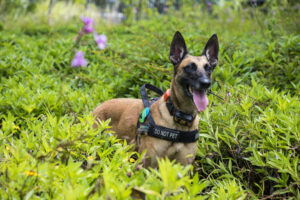
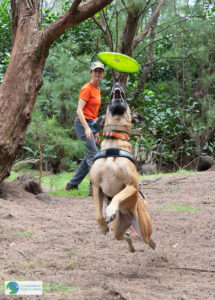
Qana learned the devil weed target quickly and turned out to be extremely well suited for the field work. She’s highly motivated to work for her frisbee (hence it’s featured in the artwork), which makes it easy to teach what we call a “target odor.” We taught Qana that the devil weed odor equals frisbee play, which then made her motivated to find the devil weed odor. And because she’s a herding breed, she tends to stay close to her handler. Why is that a good trait, you might ask. The survey environments we work in are forests with thick vegetation, so if the dog ranges too far all the time and goes out of the handler’s sight, it is more difficult to observe the dog’s scenting behaviors and support the dog’s detections, especially when the dog is less experienced. Qana will suddenly range far and start bushwhacking when she catches the scent of devil weed, so it’s easy for us to recognize that she’s “on odor” and on her way to finding a plant.
Qana has had many incredible finds over the last several years. This is why we refer to Qana as the Devil Weed Queen! She and her current owner/handler Peary have also been hired by the Big Island Invasive Species Committee to help them assess the status of devil weed spread in the Hilo side of the island. They’ll be flying out there again this winter and we are super proud of their team work.
About the Art and Artist
Bailey Brown is a scientific illustrator based in metro Detroit. We came across her work on Instagram and loved her raw, stylized artwork. We reached out to see if she’d be interested in drawing this Devil Weed Queen illustration.
See Bailey’s art below:
Website: https://www.baileybrown.com/
Instagram: https://www.instagram.com/baileyaknuds
Why are we fundraising with a t-shirt?
Our O‘ahu Devil Weed project is supported by volunteer dog teams who generously give their time to train and deploy on field surveys. Our dog trainer is also currently donating her time to train a new contingent of devil weed detection dog teams.While a volunteer project may have less costs than a paid program, there are items such as liability insurance; website and email hosting; and newsletter and Google Drive subscription fees, that help to keep CDH running smoothly behind the scenes.
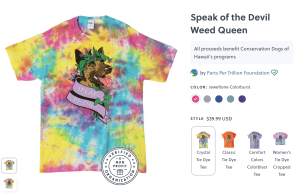
Each t-shirt sale will contribute $10 towards CDH’s operational funds and help us continue our work!
Hawai‘i Invasive Species Council’s webinar
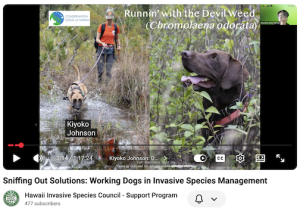
For those who want to see a more in-depth presentation on our devil weed project and the data/metrics we’ve collected, below is the link for HISC’s webinar “Sniffing Out Solutions: Working Dogs in Invasive Species Management” that we participated in. The devil weed portion starts at 3:13 and ends at 16:04.